
By Danilo Kreimer
Dan Kreimer is the founder of the Boutique Consulting Club. He contributes to three columns: Make It Obvious, Choosing You, Make It Sustainable.
You're Not Hard to Refer. You're Impossible to Describe.
Your contacts want to send you business. They just don't know how.
February 20, 2026
Friday afternoon, 3:47 PM. Elena's phone lights up with a message from David, a former colleague she worked with five years ago at Deloitte:
"Hey! Was just talking to someone who might need your help. What's the best way to describe what you're doing these days? Want to make sure I get it right."
Elena stares at the message. She's been running her boutique for three years. She has a website. A LinkedIn profile that gets updated quarterly. She's explained what she does at least a hundred times at conferences and networking dinners.
And yet.
She types four different replies. Deletes each one. Finally settles on: "We help midsize companies navigate digital transformation - happy to jump on a call if it makes sense!"
David never replies. The intro never happens.
Two weeks later, over coffee, David mentions it casually: "Yeah, I wasn't totally sure if you were the right fit, so I didn't want to waste anyone's time." He's apologetic about it. Elena is gracious. They change the subject.
Here's what neither of them says out loud: Elena isn't hard to refer because David doesn't like her or doesn't want to help. She's hard to refer because David couldn't finish the sentence. And the moment that sentence didn't come easily - cleanly, confidently, in five seconds or less - the referral died.
This happens to well-connected founders constantly. Good relationships. Strong work. Plenty of warm feelings. And referrals that should happen… almost happen. Then don't. Or they arrive misframed, attached to the wrong situation, pre-apologized for: "I told them about you but I wasn't sure exactly how to describe what you do."
The conventional wisdom says the problem is contact frequency. Stay in touch more. Follow up better. Ask at the right moment. Send quarterly check-ins. Build a referral system.
None of that explains why founders like Elena, who do all of those things, still watch referrals die in the hallway.
The real problem isn't in the relationship. It's in what happens when your name comes up in a room you're not in.
What Actually Drives a Referral
In 2016, Hinge Research Institute surveyed over a thousand professionals about what actually drives them to refer a service provider. Not what they think they should say. What actually moves them when the moment comes.
The findings completely obliterate conventional referral advice.
.png)
Visible expertise, or whether the firm is known for specific knowledge, accounted for 37.3% of what drives referrals. The single largest factor by a considerable margin.
What does visible expertise mean? Your knowledge is demonstrable to people who haven't worked with you through published thinking, named frameworks, conference talks, case studies with quantified outcomes. All of these let strangers assess your judgment before they ever meet you.
Professional relationships came in second at 23.1%. Social relationships third at 17.7%. Sponsorships and networking events combined were under 5%.
And here's the number that should make every "referral system" consultant sweat: asking for referrals accounted for 2.8%. Barely above noise.
Now, it's possible this number is low partly because most consultants don't ask consistently. They ask sporadically when desperate, not systematically. But the deeper reason asking feels uncomfortable and rare is that it goes against how referrals naturally flow: People make referrals to help a buyer find the right solution, not to help a vendor get business. Which means even systematic asking works best when backed by clear, visible expertise that makes the referral easy and safe to give
In other words, when expertise isn’t visible, goodwill has nothing to latch onto. Flip the chart over and you see the same story: the biggest killer of referrals is the absence of visible expertise (51.6%).
.png)
Strangers Refer Specialists
The pattern hasn't changed since this research was published. If anything, the digital proliferation over the past decade has made visible expertise even more decisive, since buyers now research you before they ever take a call.
But then researchers isolated reputation from relationships entirely, and found that specialized expertise generated higher referral likelihood than general good reputation, even among total strangers with no prior relationship at all.
Let that sit for a second.
People who don't know you personally are more likely to refer you if your expertise is specific and visible than people who know and like you but can't articulate what you do.
81.5% of professional services firms receive referrals from people who've never been their clients. And things get interesting when we combine this with the data with a previous Hinge publication. Referrals were asked, "if you were never a client of this consultancy you've referred people to, how do you know them?" Only 5.5% personally knew the founder or someone who worked there.
Think about what this means. Among non-clients, virtually all referrals are coming from people who don't know you at all. These are people who read, listen to, consume the expertise you publish ("expertise-based referrals"). Or hear of you through others ("reputation-based referrals").
.png)
And in credence goods markets (where buyers cannot assess service quality before, during, or even after purchase without expertise) this referral mechanism is how trust gets transmitted through networks. Your referrer is solving a trust problem the buyer has no other way to solve. That's why the sentence matters so much. It's the only signal the referrer can confidently transmit that reduces risk on both sides.
Solid relationships get you to the threshold. They create willingness. But what gets you over the threshold - what converts that goodwill into an actual referral that moves - is whether your contact can describe you clearly enough to stake their own reputation on it.
The referral problem most founders are trying to solve with CRM tactics and follow-up cadences is actually a clarity problem.
And the people quietly paying the price for that lack of clarity aren't you. They're your contacts.
The Five Seconds That Decide the Referral
Let me show you something most founders never consider: What it's actually like to be the person trying to refer you.
And if you're reading this thinking "wait, I've been on both sides of this", you're right. You have. That's exactly why this matters. You know how it feels when someone asks you to recommend a consultant and you're not quite sure how to describe them. The slight hesitation. The mental scramble for the right words. The awareness that your own reputation is on the line.
That's what your contacts experience every time your name almost comes up.
Your contact (let's call him James) is in a meeting. Someone mentions a problem. Cloud migration going badly. Legacy systems creating bottlenecks. The kind of thing you solve.
James thinks of you. For half a second, your name is right there.
Then the internal checklist runs. Not consciously, but it happens fast:
Can I describe what they do accurately?
If the answer is "sort of" or "it depends," the referral stalls immediately. James doesn't want to misrepresent you. He likes you. So if he's not confident he can explain it correctly, he stays quiet.
Will this make me look good?
A referral is a reputation stake. James is implicitly vouching: "I'm confident enough in this match that I'm putting my name behind it." If he's uncertain whether you're actually the right fit, the social risk outweighs the goodwill. Silence is safer.
Can I say it in one sentence without hedging?
"You should talk to Sarah. She specifically helps fintech companies migrate legacy banking systems to cloud infrastructure when compliance is the main blocker."
If that sentence exists in James's head, the referral happens. If what exists instead is "Sarah does consulting around digital transformation and cloud stuff, I think she could help but I'd have to check," the referral doesn't happen.
The meeting moves on. James doesn't say your name. Not because he doesn't want to help you. Because you haven't given him the sentence.
And the worst part is, you’ll never know it happened. You won't get the "sorry, I mentioned you but they went with someone else" message. You'll just not hear anything. The opportunity will pass invisibly. Your contact will feel vaguely guilty about it for a day or two, then forget. And you'll keep wondering why referrals feel so unpredictable.
Your contacts aren't failing to refer you because of anything they're doing wrong. They're failing because you haven't given them the damn sentence. And every time they hesitate (or give the vague "you should meet my friend who does consulting"), that's the cost of your indecision showing up in someone else's mouth.
Three distinct frictions create this problem, and all trace back to the same root cause.
The Three Referral Frictions
Descriptive Friction: They can't say it cleanly
Marcus runs a boutique focused on "helping organizations become more data-driven." He's good at what he does. His clients love him. But when his former colleague mentions him to a peer, it sounds like this: "I know someone who does data strategy stuff. Not sure exactly what the scope would be, but happy to connect you."
The peer nods politely. Never follows up.
Marcus thinks the problem is that his colleague didn't push hard enough. The real problem is his colleague didn't have the words. "Data strategy stuff" could mean anything. Dashboard design? Data governance? Building a data science team? The more contextual and situational your offer, the more your referrer has to improvise. Most people don't. They stay quiet, or they give a half-sentence that doesn't land.
And you can feel this in conversations with your own contacts. Someone asks what you do. You explain it. They nod enthusiastically. "That's great! I'm sure I know people who need that." Then... nothing. Because in the moment you explained it, it made sense. But two weeks later when they're in a conversation where you'd be relevant, they can't reconstruct your explanation. The words are gone.
Confidence Friction: They're not sure enough to stake their name on it
Rachel has a clearer pitch than Marcus. "I help mid-market SaaS companies optimize their pricing." Specific service, specific buyer. But her contacts still hesitate.
Why? Because they're not sure who she's for. Is a $10M ARR company mid-market? What about a company that just crossed $50M? Does she work with B2B or B2C? Horizontal SaaS or vertical? Usage-based pricing or tiered?
Rachel can answer all of this in a conversation. But her contacts don't have that conversation in their heads. So when a situation shows up that might be a fit, they're not confident enough to make the intro. And when you're not confident, you protect your reputation by staying quiet.
This is the friction that makes you want to scream. Your contact knows you're good. They want to help. But that last 10% of certainty, the confidence that this specific situation is right for you, never quite materializes. So the referral dies not from lack of goodwill, but from an abundance of caution.
Match Friction: They don't know when to think of you
Tom has strong positioning. He helps PE-backed software companies prepare for technical due diligence before acquisition. Clear buyer, clear situation, clear value. His contacts can describe it. They're confident about the fit when he explains it.
But they still don't refer him often enough. Because they don't recognize the trigger in real time.
A contact hears someone mention they're "exploring strategic options." Tom doesn't come to mind. Three months later, when the deal is already in due diligence and the technical review is a nightmare, the contact thinks: "Oh, I should have mentioned Tom."
Too late.
Match friction is about when you come to mind. If your positioning doesn't include a clear trigger (the specific moment or situation that makes you the obvious call) you'll live in the "I should have thought of you" zone permanently.
Your contacts will apologize for not thinking of you sooner. You'll tell them it's fine. And you'll both move on, neither of you realizing that the problem isn't memory or attention. It's that the trigger was never defined clearly enough to create the association.
Common triggers that work:
- Funding events: Series A close, Series B preparation.
- Regulatory changes: New compliance requirements, audit failures, GDPR or SOC2 mandates.
- Leadership transitions: New CTO hired, CFO change, founder stepping back from operations.
- Growth inflection points: Crossing $10M ARR, opening second office, first international expansion, launching new product or service.
- External pressure: Competitive threat, acquisition offer received, failed security audit.
- Time-based cycles: Annual planning season, quarterly board prep, fiscal year-end.
Your positioning should include one or two of these, specific enough that your contact recognizes them when they appear in front of them.
This applies whether you're positioned by problem ("I help with X when Y happens") or by vertical ("I only work with healthcare companies"). Even industry-specific positioning needs a trigger. "We work with healthcare companies" still leaves your contact wondering: When? At what stage? For what kind of problem? The trigger might be "when they're preparing for a major regulatory change" or "when they're scaling from regional to national". But it has to be there, or you're just a name without a context.
.png)
All three frictions are symptoms of the same root cause: the absence of a clear, committed entry point. The offer that's "whatever the client needs" produces all three simultaneously.
Serendipity Is Expensive
Let's be honest about something the data doesn't capture: sometimes the unclear referral leads to your best work.
Someone says "you should talk to my friend who does consulting," you get on a call, there's no clear brief, and through the discovery conversation you uncover a problem neither of you expected. Six months later, it's your biggest engagement of the year.
This happens. And it's one of the reasons founders resist narrowing their positioning - they don't want to filter out those serendipitous opportunities.
But for every vague referral that worked, how many died before they reached you? How many times did a contact almost mention your name, couldn't find the words, and stayed silent? You'll never know. The opportunities you lost to vagueness are invisible. The ones that made it through are memorable.
And even when vague referrals do convert, they're expensive. The sales cycle is longer. The qualification takes more time. The client isn't pre-sold on your specific value, so you're starting from zero trust instead of halfway up the ladder. It works, but it's inefficient.
The argument for clarity isn't that vague referrals never succeed. Clarity increases the rate of referrals, improves their quality, and reduces the friction of converting them. You're not trying to stop vague referrals from happening. You're trying to make precise referrals happen more often.
Activity Is Volume. Clarity Is Conversion.
You can have the clearest positioning in the world. Your contacts can know exactly how to describe you. But if you haven't talked to them in eight months, you're not coming to mind. Period.
Most founders dramatically underinvest in business development. They get busy with delivery, tell themselves they'll "get back to networking next month," and wake up six months later with a dry pipeline wondering why referrals stopped flowing.
The essay you're reading right now is about clarity. But clarity without consistent relationship activation is like having a perfect product with no distribution. It doesn't matter how referable you are if no one's thinking about you.
So let's be precise about what the actual problem is:
Lack of activity is a volume problem. Lack of clarity is a conversion problem.
If you're not doing enough business development - meaning nurturing relationships, creating visibility, showing up in your network's world regularly - you won't get enough referral opportunities for clarity to even matter. You need at-bats.
But if you're active and visible and still watching referrals die or arrive wrong-fit, that's a clarity problem. That's when the positioning work becomes the highest-leverage move you can make.
The two aren't in opposition. They compound each other. Clear positioning makes every conversation more productive. Consistent activity creates more opportunities for that positioning to work. But you need both.
Founders know they should be doing more outreach, more networking, more visibility work. So they focus there first. They build the CRM system. They set the coffee meeting goals. They write the LinkedIn posts. All of this is good.
But if the underlying positioning is still fuzzy, all that activity is pushing water uphill. Your contacts are willing to help, they're just not equipped to.
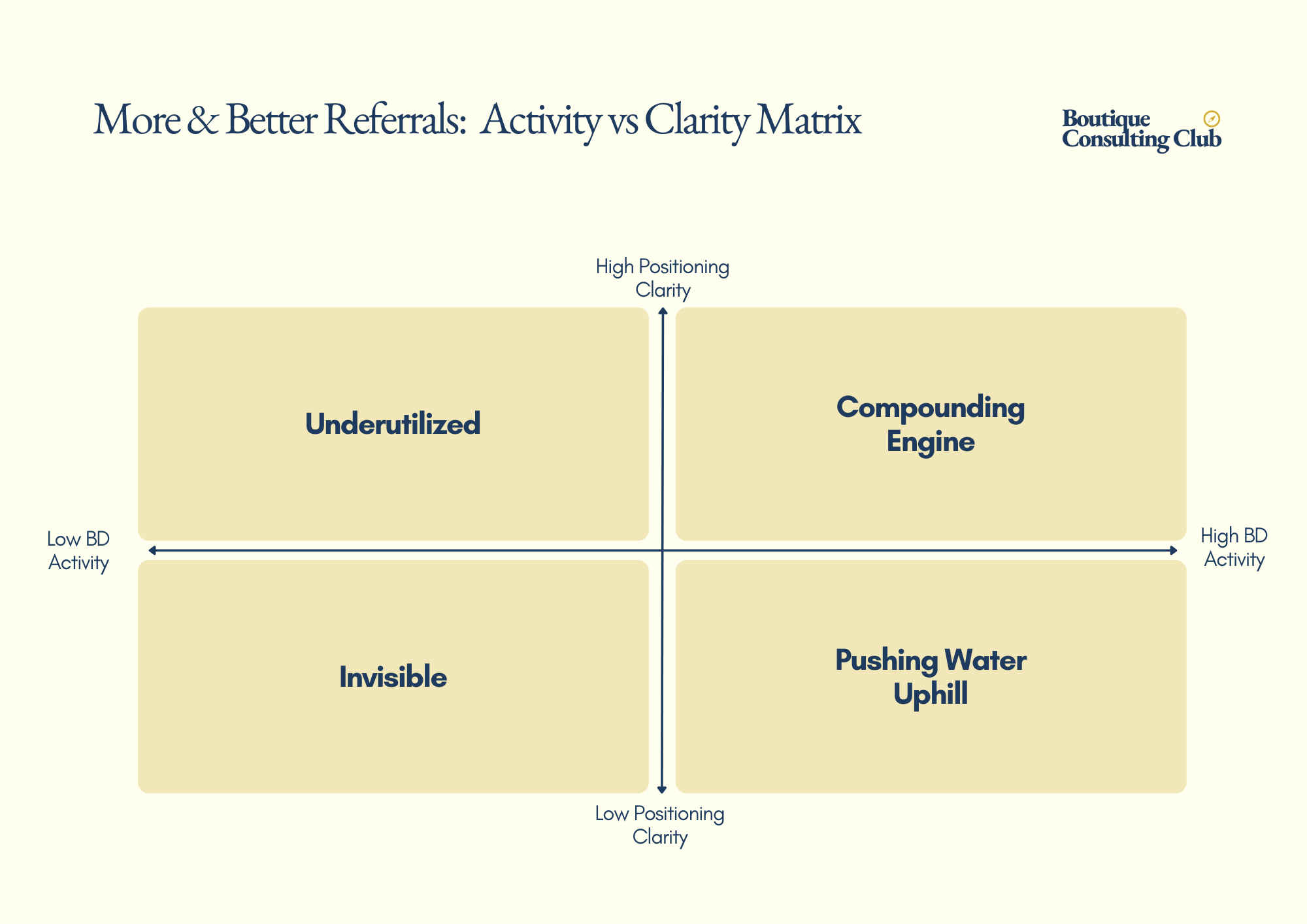
That’s the right diagnostic question: Are referrals slow because you're not visible enough, or because you're not describable enough?
When asked, most boutique founders admit underinvesting in business development. What they don't see is how unclear positioning sabotages whatever activity they do manage to generate. You can't fix both problems at once. But if you're visible and referrals still aren't compounding, don't let activity mask the clarity problem.
All the coffee meetings in the world won't fix descriptive friction.
Clarity Requires Commitment
You might be reading this thinking: "Fine, I just need to write a clearer tagline."
No. The sentence doesn't exist because the decision behind it hasn't been made.
Try this test right now: Write down the single sentence a contact would give to refer you. One sentence, no context, no caveats. The thing they'd say in a hallway when your name comes up.
If you can't do it cleanly, or if you realize the sentence changes depending on which contact you're imagining, that's not a copywriting problem. That's a strategic problem.
Most boutique founders haven't chosen what to lead with. Not because they lack options. Because they have too many, and every option represents a client or capability they're afraid to leave behind. So they keep everything open: multiple services, multiple narratives, multiple "entry points depending on what the client needs."
From the inside, this feels like flexibility. From the referrer's outside, it's fog.
I worked with a founder (let's call her Nina) who'd been running her boutique for four years. Smart, credible, good clients. But referrals were inconsistent and almost always wrong-fit. When we asked her closest contacts what she did, here's what came back:
- Contact 1: "She does change management, mostly for big digital transformation projects."
- Contact 2: "She helps companies adopt new technology. I think mostly in retail."
- Contact 3: "I think we could call it org design? But maybe also a bit of training. It definitely helps getting teams aligned."
Three people who'd worked with her directly. Three completely different sentences. None of them wrong, exactly. But none of them right enough to generate confident referrals.
The problem wasn't Nina's relationships. Nina had never committed to what she wanted to be known for. So each contact extrapolated from their own limited experience with her work, and the result was a fractured, unreferrable positioning.
The sentence your network needs to give is one you have to write first. Not as a tagline. As a strategic commitment: one thing to lead with, one type of situation where you're the obvious call, one frame that holds up without you there to explain it.
That decision feels constraining. It feels like closing doors. And if you're thinking "but I'm past the single-offer stage, I have three service lines that all work" - I hear you. It’s great to be able to offer different solutions. But until you're past $1M in revenue, adding services faster than you can operationalize them is the single biggest drag on growth.
I've written about the "ten-minute window" problem before. Every new service you add fragments your positioning, splits your team's focus, and creates handoff complexity that clients can feel. The boutiques that scale fastest are the ones that resist the urge to diversify too early.
If you're under $1M, you almost certainly benefit from radical focus on one entry point. Once you're past that threshold and you've built the operational capacity to deliver multiple services well, then you can layer. But even then, you still need a clear front door. The thing you're known for, the offer that starts most relationships.
Complexity is expensive. It's expensive in delivery. It's expensive in marketing. And it's especially expensive in referrals, because every additional service line your contacts have to keep straight is another chance for the sentence to break down.
Three Filters for Commitment
If you're sitting here thinking "I understand all of this, but I genuinely have two or three strong directions and I don't know which one to commit to", you're not alone. That paralysis is real. And it's expensive.
There's no formula that will tell you which direction is "right." But there are three questions that cut through most of the noise.
Which one already has proof?
Not proof that the market exists. Proof that you can win in it. Past client results you can point to. Testimonials that sound credible. Case evidence that would survive scrutiny from a skeptical buyer.
The positioning that comes with the most proof is the most credible one. That matters more than most founders realize, because in professional services, buyers are assessing risk more than opportunity. The option with proof reduces their risk immediately.
If you're torn between "the thing I've done 15 times" and "the thing I think could be bigger but have only done twice," the answer is almost always the former. At least until you're past $1M and have the operational capacity to place multiple bets. Pre-$1M, proof beats potential every time. A $500K niche you can dominate is better than a $50M market where you're unproven. You can always expand later once you have credibility.
Which one can you stay interested in for three years?
Positioning isn't a six-month experiment. It's a multi-year commitment. You're going to be talking about this problem, writing about this problem, sitting in discovery calls about this problem hundreds of times.
If the positioning makes you quietly exhausted just thinking about it, that's a signal. Choose the one you can stay genuinely curious about. If you get bored you’ll start to drift, and your hard‑won clarity will fall apart.
Which one gives you the sentence right now?
Write down the single sentence a contact would give to refer you in each direction. Don't spend more than two minutes per option. Whichever sentence comes out clearest and most confident, that's probably your answer.
If you can't write a clean sentence for any of them, you're not actually stuck between strong directions. You're stuck between vague ones. Go back and add specificity until the sentence writes itself.
A simple guardrail: You're too narrow if fewer than 8-10 consultants or firms match your positioning (problem + ICP). You're too broad if it’s more than 30, and/or you can't name specific buying triggers that make you the obvious call.
These aren't perfect tests. But they're better than waiting for certainty that will never arrive. The biggest mistake isn't picking the "wrong" direction, but deferring the decision so long that you stay unreferrable for another year.
The Sentence Formula
The sentence isn't a tagline. It's not clever. It's a clear, confident statement of who you help, when, and with what.
The structure is simple:
"[Your name] helps [specific type of company] [achieve specific outcome] when [trigger situation]."
Examples:
- "Sarah helps fintech companies migrate legacy systems to cloud infrastructure when compliance requirements change."
- "Marcus helps B2B SaaS companies between $5M-$20M ARR build their first repeatable sales process when they're transitioning off founder-led sales."
- "Tom helps PE-backed software companies prepare for technical due diligence in the 6 months before acquisition."
Notice what these have in common: a clear buyer, a clear trigger, a clear outcome. No jargon. No hedging. No "and also we do..."
If your sentence requires a follow-up explanation, it's not done yet.
What Clarity Unlocks
I'm not saying a clear positioning sentence magically solves everything. I'm saying it's the precondition for referrals to compound instead of staying random and inconsistent.
Again, look at the data. Does getting a referral translate into new business? Absolutely not. 52% of respondents have ruled out referrals before they even speak with the firm in question. And surprise, surprise... the top reason for ruled-out referrals (44%) was a lack of clarity about the provider’s services, expertise, or capabilities. Followed by "the material seemed more focused on selling than helping my firm" (33%) and "they didn’t seem to be a good cultural fit with my firm" (31%).
It's all lack of positioning clarity, folks. People don't understand how you can be of help. You fail to communicate it. Referrers can't identify good fit prospects to introduce you to.
When you finally make the hard decisions to make a clear stand, things shift.
- Referrals arrive better qualified. When your contact can describe you specifically, they're pre-filtering for fit before they even make the intro. You stop getting the "might be relevant?" intros that go nowhere. You start getting: "This is exactly the thing she does."
- Contacts refer more often. The cognitive and social cost drops. They don't have to hedge, qualify, or wonder if they got it right. The sentence is easy to give and safe to give. So they give it.
- Second-degree referrals start appearing. People who've never met you start referring you because they've heard the sentence from someone who does know you. "I don't know her personally, but I know she specifically helps SaaS companies design pricing for enterprise deals — that's your exact situation."
- The confidence friction disappears. Remember Rachel's contacts, who weren't sure if she was right for a $10M vs. $50M company? When the positioning includes the boundaries ("I work with B2B SaaS companies between $5M-$25M ARR when they're transitioning from founder-led sales to a repeatable motion") your contacts know when to refer you and when not to. That clarity protects you from bad-fit leads and protects them from looking bad. Watch out though: People need to remember it! Adding too much in there creates descriptive friction.
Specificity does trust-building work that relationships and reputation alone cannot. It removes the referrer's risk. It gives them the sentence. It turns your network from a collection of people who "might" refer you into a distribution engine that actively looks for opportunities to say your name.
Give Them The Damn Sentence
The referral problem most boutique founders are trying to solve with relationship tactics is often a clarity problem. If you’re investing enough time in business development, the fix isn't in your CRM. It's not in your follow-up cadence or your quarterly check-ins. It's in a decision that most founders keep deferring because it feels like they're closing doors they're not ready to close.
But every day you defer it, you're making your contacts complicit in your positioning problem. They want to refer you. They just don't know how.
What's the sentence your contacts would give right now if your name came up in a room you weren't in?
If you don't know, or if you know the answer changes depending on who's doing the referring, that's the work to be done.
Not more networking. Not a better LinkedIn bio. The decision about what you specifically do, for whom, and when. That's what makes you referable. Everything else is maintenance.
Your network is waiting. The goodwill is already there. What's missing is the sentence.
If you're not sure what that sentence should be (or if it keeps changing depending on who's asking) that's exactly what the First Yes Session is designed to resolve. A 90-minute working session to define one clear entry point: the specific offer someone in your network can say yes to, framed in language that travels without you in the room.