
By Danilo Kreimer
Dan Kreimer is the founder of the Boutique Consulting Club. He contributes to three columns: Make It Obvious, Choosing You, Make It Sustainable.
The Growth Journey Nobody Mapped For You
Why the textbook stages of a consulting firm don't describe the firm you're actually building.
April 8, 2026
Nadia launched her data engineering consultancy fourteen months ago. Three clients. Revenue approaching €400K. Calendar full. She'd kept a contract data architect gig because it paid well and she wasn't ready to turn down income. But her actual consultancy - the thing she built to escape the corporate hamster wheel - was working. Clients were happy. Work was referral-driven. She'd even turned down a fourth engagement because she didn't have the hours.
Tuesday morning. A message from a former colleague: "Heard you're doing great. I've got a client who needs exactly what you do. Interested?"
Nadia stared at it for six minutes. She wanted to say yes. She couldn't say yes. Not without working weekends or compromising delivery. And she knew - in the way you know things you've been avoiding - that hiring someone wouldn't just add capacity. It would change everything about how the firm ran. Who does the selling when you're the product? Who owns the client relationship when the client hired you personally? How do you maintain quality when the work leaves your hands and lands in someone else's, and your name is still on the invoice?
She closed the message. Opened it again. Closed it.
She wasn't stuck because of a market problem. She was stuck because her firm was designed for one person, and it had reached the edge of what one person can do.
This is the most common story in boutique consulting. Not the dramatic kind: nobody's going bankrupt, nobody's getting fired. It's the quiet kind. The kind where things are objectively going well and you still can't sleep.
You're saying no to work you once prayed for. Your calendar is a wall of delivery. You haven't done meaningful business development in weeks because the pipeline feels fine (until it doesn't). You're running fast enough to maintain altitude but too fast to change direction. And somewhere in the back of your mind, a thought you keep pushing away: "I might be building a trap."
Not a failing business. A successful one that slowly becomes a prison.
If you go looking for help - books, frameworks, models of "how consulting firms grow" - you'll find a surprisingly thin shelf. And most of what's on it was written for firms that look nothing like yours.
What the Textbooks Actually Say
The canonical growth models come from general management theory. Larry Greiner published his framework in the Harvard Business Review in 1972. The core insight: firms grow through stable phases, each ending in a crisis. Creativity leads to a leadership crisis. Direction leads to an autonomy crisis. Delegation leads to a control crisis. And so on, through six increasingly bureaucratic phases.
Greiner was writing about corporations. Manufacturers. Retailers. His model describes what happens when you add hundreds of people across functions and divisions. It's not wrong for consulting firms - the crises he names are real. But it was calibrated for organizations where the product is a thing, not a relationship. A consulting firm doesn't grow by adding production capacity the way a factory does. It grows by replicating trust. That's a different constraint entirely, and Greiner's model doesn't address it.
Churchill and Lewis (HBR, 1983) got closer. They identified something critical for consulting founders: at the "Success" stage, the owner faces a fork. You can coast at a comfortable size, running what is essentially a well-paid job with your name on the door. Or you can commit to growth - invest, take risks, build something that might eventually exist without you.
The literature calls this a "stage." I'd call it a fork in the road that most founders walk past without realizing they've made a decision. Not choosing is a choice. It just doesn't feel like one until the consequences arrive.
David Maister's Managing the Professional Service Firm (1993) is still the definitive text on PSF economics. If you run a consulting firm and haven't read it, fix that. But Maister was writing about law partnerships, Big Four accounting practices, and established consultancies with hundreds of people. His leverage model (the ratio of junior to senior staff, and how that ratio drives profitability) is brilliant structural analysis. At 50+ people. At five people, it's a useful lens but not an operational guide.
Maister's most important warning for boutiques: "There is not necessarily a relationship between growth and profits." Adding a person can increase revenue and decrease profit simultaneously. I've seen this happen. Founders who hire their first consultant and discover six months later that they're working harder, earning about the same, and managing someone on top of it. Maister saw this in the 1990s. It hasn't changed.
Professor Joe O'Mahoney's Growth (Routledge, 2021) is the most relevant work for the specific firms I write about. Based on interviews with 72 founders who grew and sold their consultancies, two international surveys, and a long career researching the consulting industry, O'Mahoney provides the first evidence-based growth guide for small firms.
His opening line of defense: "Although small consultancies (1–20 people) represent around 97% of all firms in that sector, there is surprisingly little quality research done on the strategies and tactics linked with growing profitable consultancies." The reasons? Survivorship bias in founder stories, academic preference for studying McKinsey over your three-person shop, and the fact that most business professors aren't all that interested in straightforward questions like "how do you make a profit."
Where Maister mapped the economics of established firms, O'Mahoney mapped the messy, evidence-backed journey of small ones - founding, growth, and exit, with all the wrong turns in between.
All of this work is valuable. But none of it was written for the firm you're building right now.
The Math That Actually Matters
Before we get to the growth journey itself, there's a piece of structural reality that every model I've read either ignores or buries in a footnote. It's not a management insight. It's arithmetic.
Robin Dunbar, the British anthropologist, is famous for the number 150 - the maximum stable social relationships a human brain can maintain. But the number that matters for boutique consultancies isn't 150. It's 5. And 15.
Dunbar's research identifies thresholds at 5 (intimate, high-trust relationships), 15 (good friends, people you'd invite for dinner), 50 (the circle where one person can still track everything), and 150 (the outer limit of personal recognition).
The communication formula is simple: the number of possible one-to-one channels in a group equals n(n-1)/2. Five people: 10 channels. Ten people: 45. Fifteen people: 105. Fifty people: 1,225.
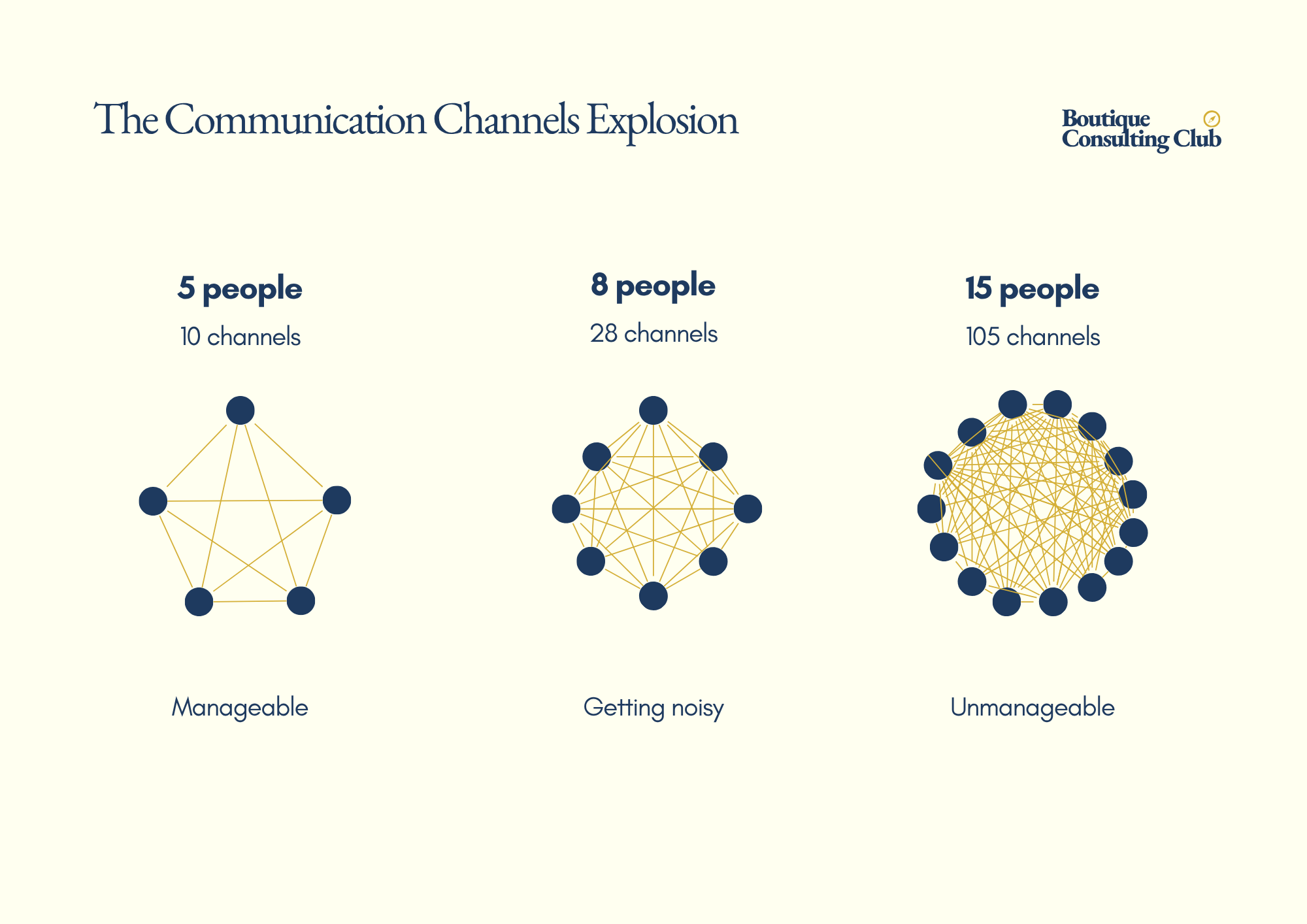
That's not a management metaphor. It's the structural reason why your firm feels qualitatively different at 8 people than it did at 4. At five, everyone knows everything. You don't need a Slack channel for updates because updates happen in the conversation you're already having. At fifteen, conversations happen without you. Decisions get made you didn't know about. A client email sits unanswered for two days because nobody was sure who was supposed to reply. Quality drifts. Not because people are careless, but because you're no longer in every room.
The transitions at 5 and 15 are where early stage boutique consultancies break. Not always dramatically. Sometimes it's just the slow accumulation of friction - meetings you didn't need when there were four of you, misunderstandings that didn't happen when everyone was on the same call, a creeping sense that you're spending more time coordinating work than doing it.
The Bottleneck Nobody Talks About
Every model I've cited (Greiner, Churchill and Lewis, Maister, O'Mahoney) describes what needs to change in the organization at each growth stage. Structure. Systems. Staffing. Delegation. But we find very little description of what needs to change in the founder.
Recent academic work uses a phrase I find uncomfortably precise: the "Identity Threshold." The idea is that revenue plateaus at growth transitions are not just operational bottlenecks. They're autobiographical ones. The point where the leader's self-concept - the story they tell themselves about who they are and what makes them valuable - runs out of capacity to generate further growth.
Let me make that less academic.
You left a senior role at a large firm because you were good at something. Cloud architecture. Data strategy. Cybersecurity. Your entire professional identity is built on being the person who does excellent work. Clients hire you because you're you. Your reputation is the firm. Your judgment is the product.
Now someone tells you to hire, delegate, systematize. To let someone else deliver the work with your name on it. To spend your time on "business development" instead of the craft that defines you. To become, essentially, a manager - the thing you left corporate to escape.
The Identity Threshold isn't about lacking management skills, but the psychological reconstruction required to go from "I am an expert who does excellent work" to "I am a leader who ensures excellent work gets done." No training will close this gap. It's an identity crisis that most founders experience alone, usually around 11 p.m. on a Thursday, and never talk about.
The bottleneck isn't operational. It's autobiographical.
And it shows up in very specific ways. You find yourself doing work a junior could do because it's comforting. You avoid hiring because nobody will do it as well as you. You take on a project you shouldn't because saying no feels like admitting a weakness. You resist systemizing your delivery because "every client is different" (which is partly true and partly a defense against letting go).
The founders who cross this threshold don't do it by learning to delegate. They do it by rebuilding their relationship with the work itself. They stop measuring their value by what they personally deliver and start measuring it by what the firm delivers without them in the room. That's a different kind of success. It feels, for a while, like a different kind of loss.
What You're Actually Experiencing
Let me describe what the transition stage looks like in daily life, because the models make it sound clean and it isn't.
You're avoiding outreach because you can't absorb more work. You know you should be having conversations with potential clients. You know the pipeline will dry up if you stop. But you're at capacity, so every new conversation feels like a threat rather than an opportunity. You start unconsciously self-sabotaging your own business development. Not replying to that LinkedIn message, postponing that coffee, letting that warm intro sit in your inbox.
Your proposals are inconsistent. When you had two clients, every proposal was bespoke and excellent. Now you're writing them at 9 p.m. after a full day of delivery. Some are great. Some are rushed. You can feel the quality variance but can't fix it because fixing it means creating a system, and creating a system means admitting this isn't a temporary capacity problem.
Clients are buying you, and that makes delegation feel impossible. The person they trust, the person they chose, the person whose judgment they're paying for - that's you. Not your firm. Not your methodology. You. So every conversation about "building a team" runs into the same wall: how do you delegate the thing the client specifically bought? (The answer is less scary than it seems. But it requires redesigning the offer, not just hiring a body.)
You're overusing contractors because hiring feels risky. Contractors are commitment-free. You can spin them up and down. Nobody depends on you for their livelihood. But contractors don't build your IP. They don't own client relationships. They don't learn your methodology and improve it. They do what you tell them and send an invoice. The firm doesn't get smarter. It just gets busier.
You feel trapped between “too successful to experiment” and “too small to invest.” You can't afford the risk of trying new things because you're fully utilized. But you can't afford not to because you can see the ceiling. So you do nothing. You maintain. You tread water at a revenue level that looks like success from the outside and feels like stagnation from the inside.
And underneath all of it: a quiet suspicion that you might be recreating the thing you left. The long hours. The meetings. The compromises. The sense that the work is running you rather than the other way around. You didn't leave Deloitte to become a worse version of Deloitte with worse coffee and no IT support.
If this sounds familiar, you're not broken. You're at a transition point. And the models that were supposed to map this territory for you were drawn for a different landscape.
.png)
Why the Old Map Doesn't Fit
Most growth models I've reviewed - and I went through a lot of them for this piece - shares one foundational assumption: that revenue growth requires proportional headcount growth. More revenue means more people. More people means more management. More management means more structure.
For a traditional consulting firm, this was true. Maister's leverage model depends on it. The pyramid exists because you need bodies to bill hours. Revenue per person is the core unit of analysis. Growth means scaling the workforce, managing utilization rates, and maintaining the junior-to-senior ratio that makes the economics work.
For the kind of firm most tech boutique founders are building today, this assumption is fracturing.
I've written elsewhere about the double squeeze - AI deflating the cost of codifiable tasks while execution platforms slide upstream and bundle "lite advisory" into their products. And I've written about the shape question - why the consulting pyramid is giving way to leaner structures like the obelisk (senior-heavy, AI-amplified, almost no base) and the diamond (strong middle, thin base, tiny apex).
Those pieces were about the strategic picture. This one is about the daily reality. Because it's one thing to say "the old model is changing." It's another to figure out what that means when you're sitting at your kitchen table on a Tuesday morning, staring at a message you can't say yes to.
Here's what I think is actually different for tech boutique founders building today:
Revenue can grow without proportional headcount. Through AI-augmented delivery, productized offerings, retainers, and contractor networks, a small team can generate revenue that would have required a much larger team five years ago. This isn't hype. I've talked to founders running three-to-five-person firms generating revenue in the range you'd expect from teams of 10 or 15 in a traditional model. The exact ratio depends on the practice area, the pricing, the degree of AI integration (I'd be lying if I gave you a clean multiplier). But the direction is clear: the link between headcount and revenue is loosening.
But the link between headcount and relationships is not loosening. AI can do research, synthesis, and first-pass analysis. It cannot own a client relationship. It cannot read the politics in a room. It cannot build the trust that makes a client call you at 8 a.m. when something goes sideways. The constraint is moving from "we don't have enough people to do the work" to "we don't have enough people to hold the relationships."
And the link between headcount and quality is not loosening either. A senior person reviewing AI output can maintain quality at scale. But "reviewing AI output" is itself skilled work. It requires judgment about what the AI got wrong, what it missed, whether it optimized for the wrong thing. Without that judgment layer (what the HBR has started calling "engagement architects") you get speed without reliability. Clients figure this out fast.
So the growth journey for a tech boutique isn't the classic staircase: grow, hit a management ceiling, restructure, grow again. It's more like a series of ramps where the bottleneck at each stage is different from what the textbooks predict.
.png)
The Terrain (Not a Prescription)
I want to be careful here. I'm not going to lay out a five-stage model and tell you this is the path your firm will take. I don't know your firm. I don't know whether you want a team of twelve or a highly profitable solo practice with smart tooling and two contractors. Both are legitimate. Both can work. The choice between them is yours, not mine.
What I can do is describe the terrain that founders in this space tend to encounter. Think of it less as a roadmap and more as a topographical map - here's where the hills are, here's where the ground gets soft, here's where other people have gotten stuck. Your route through it is your business.
The early solo stage is straightforward in structure if not in execution. You have expertise. You're selling time. Revenue equals hours times rate. The bottleneck is almost always demand - finding enough consistent work to justify the leap from employment. Most founders underestimate how long this takes. Credentials matter less than you think. What matters is whether you can name a specific problem that a specific buyer is willing to pay to solve right now.
.png)
The augmented solo is a category that barely existed three years ago. You're using AI tools, contractor networks, and possibly a VA to punch above your weight class. Revenue can reach surprisingly high levels with no permanent staff. This is the stage where a lot of tech founders feel like they've found the cheat code - all the upside of a firm, none of the management headaches.
The fragility here is subtle. The model works as long as you can personally oversee everything. The moment you can't (a second major engagement overlaps, a contractor delivers something off-brand, a client needs a response while you're in a workshop) the cracks show. David Fields calls this the "reverse barbell" and notes that it "can succeed up to a point" but that "the top tends to be unstable as it expands." That matches what I've seen. It's a strong model at low volume. It gets brittle as demand increases. And the irony is that the better you are, the faster it gets brittle, because more people want to work with you.
The first real team - whether that's three people or five, whether they're employees or a stable pod of associates - is where the fundamental change happens. You're no longer a solo practitioner with help. You're a firm. And a firm has different physics.
The questions that define this stage aren't strategic. They're operational and emotional at the same time:
- Who sells? If it's still only you, you've added delivery capacity but not commercial capacity. The pipeline still depends on your personal bandwidth.
- Who owns the client? If every client relationship runs through you, you haven't built a firm. You've built a more complex version of a solo practice.
- What's repeatable? If every engagement is bespoke and the methodology lives in your head, you can't train anyone to deliver it. And you can't go on holiday.
What breaks first? Usually quality control. The second thing that breaks is the founder's time - suddenly 40% of your week is coordination, and you're doing the work you used to do in the remaining 60%.
Beyond the first team, things diverge too much to generalize usefully. Some founders build toward a productized offering that generates revenue without billable hours. Some deliberately cap the team and focus on increasing revenue per person through pricing and offer design. Some add a second pod. Some bring in a commercial partner to handle business development while they focus on delivery. Some realise they actually want to go back to being a solo practice (and that's not a failure, but a design choice).
The one thing I will say about the later stages: the bottleneck shifts from operational problems to IP and systems problems. The question is no longer "can we deliver this project?" It's "can we deliver this project the same way twice, without the founder in the room, and have the client be just as happy?" If the answer is no, you've built a talent agency, not a firm. Nothing wrong with a talent agency. But the economics and the exit options are different.
The Honest Caveats
I've been asserting things in this piece that I believe to be directionally true but can't prove with the rigor of a peer-reviewed study. Let me name what I'm less sure about.
I don't know exactly where the "reverse barbell" model cracks. I said it gets brittle as volume increases. That's a pattern I've observed, not a law of physics. I've also seen founders run the augmented solo model at high revenue for years without apparent strain. Whether they're quietly burning out or genuinely content is something you can only know from the inside.
I don't have a clean multiplier for "how much more productive an AI-augmented team is." The "2–3x" numbers floating around in industry reports are based on specific tasks (research synthesis, first-pass analysis, document generation) and don't transfer cleanly to an entire engagement. Some engagements are 80% relationship and 20% analysis. AI doesn't help much with the 80%.
I'm also not certain that the pod model scales as neatly as I've suggested. It depends enormously on the type of consulting, the client buying pattern, and the founder's appetite for management. A three-person pod delivering AI implementation sprints is a different animal from a three-person pod doing C-suite advisory.
And I'm aware that presenting a terrain map with named stages risks doing the very thing the feedback on this essay warned about: presenting one plausible path as the terrain. It's not. It's a plausible terrain. There are others. The founders who navigate this transition well are the ones who hold the map loosely - using it to understand the general shape of the landscape while making decisions based on what they actually see in front of them.
What the Literature Missed
What none of the growth models capture is the specific problem that tech boutique founders face at the $400K-$1.5M stage. It's not a management problem. It's not a positioning problem. It's not even a hiring problem, although hiring is part of it.
It's a commercial architecture problem.
The pipeline that got you your first three clients was built for one person. It accumulated through relationships, referrals, former colleagues, conference encounters, lucky timing. And that accumulation worked. It got you here. Revenue is real. Clients are happy.
But the thing that accumulated can't compound. A referral from a former colleague doesn't generate a second referral with any reliability. A reputation for good work doesn't automatically translate into a brand that someone other than you can sell. A network that produced three clients in eighteen months might produce three more in the next eighteen - or it might not. You don't know, because there's no system. There's just you, being good at your job and hoping the phone keeps ringing.
The founders who cross this transition - the ones who build something that generates pipeline for a team, not just a solo practice - don't do it by working harder at business development. They do it by designing the engine deliberately. The positioning. The offer architecture. The BD system. The content footprint. The relationship management. The way the firm shows up in the market when the founder isn't personally showing up.
That's what I mean by commercial architecture. Not marketing. Not sales training. Not a new website. The deliberate design of the system that makes a consultancy grow without requiring the founder in every conversation.
It's the thing I work on. Not because it's the only problem that matters, but because it's the specific one that the existing frameworks leave unaddressed, and it's the one that determines whether a good solo practice becomes a firm or stays a very busy trap.
What Stays True
The growth journey for a tech boutique in 2026 looks different from what the textbooks describe. The shapes are changing. The economics are changing. The tools are changing. AI has compressed the base of the delivery pyramid. Pods have replaced hierarchies. Revenue can grow without proportional headcount.
But some things haven't changed at all.
Trust is still the product. The communication math still applies. The 5-person threshold still exists. The identity reconstruction that growth requires is still the hardest part. The fork between "lifestyle practice" and "growing firm" is still real, and still easy to walk past without noticing.
And the most common failure mode is still the same one it's always been. Not a lack of expertise. Not a bad market. Not poor delivery. But a commercial engine that was never designed - one that accumulated from a series of fortunate events and now can't generate what the next stage requires.
What accumulated can't compound. That's the problem. And it's worth taking seriously, because the founders who solve it early get options. And the ones who don't get busier.