
By Danilo Kreimer
Dan Kreimer is the founder of the Boutique Consulting Club. He contributes to three columns: Make It Obvious, Choosing You, Make It Sustainable.
Why the Pipeline That Built Your First $500K Won’t Build Your Next
Most founder-led consultancies mistake reputation for a commercial engine - until growth stalls.
April 27, 2026
Thursday evening. Tim had just closed his laptop on a $95,000 proposal. The client was a Series B fintech - an introduction from a former colleague at Deloitte, the third introduction that colleague had made in eighteen months. The call had gone well. The work was squarely in his domain. The client was happy. He’d probably sign.
He opened a spreadsheet he’d been meaning to update for two months. Pipeline. He started filling in the rows.
Deal one: introduced by a former manager at IBM. Deal two: a direct call from a former colleague who’d moved to a PE-backed infrastructure firm. Deal three: the fintech just now. Deal four, from four months ago: another Deloitte introduction, different branch. Deal five: a referral from a client he’d stayed close to since 2018.
He sat back. Every single row traced back to a relationship he’d built in the decade before he launched his firm.
His firm was two years old. Revenue was $420,000. The work was good. The clients were happy. And he had, at that moment, no clear idea where the next $200,000 was coming from - because the people who had generated the first $420,000 had already made their introductions. They weren’t gone. They were just exhausted. Referral capacity, it turns out, is finite.
What Tim had built was not a pipeline. It was a reputation system. And reputation systems built entirely on personal relationships have a structural ceiling that no amount of talent or effort can push through.
This isn’t a cautionary tale about Tim. It’s a description of how most founder-led technical consultancies are actually built, and why the architecture that works brilliantly in years one and two becomes the thing that prevents growth in years three and four.
The Structural Illusion
Most founder-led technical consultancies are built on what feels, in the early years, like solid commercial traction. Former colleagues reach out. Former managers refer clients. Former clients follow the founder to the new firm. The work flows, proposals convert, revenue climbs, and the whole thing feels like evidence that the business is working.
It is evidence of something. Just not what founders think.
What early revenue proves is that the founder’s personal credibility (built over 10, 15, 20 years at Accenture, Deloitte, IBM, or wherever they came from) is strong enough to generate warm trust at close range. Former colleagues hire them because they know what they’re getting. Former clients refer them because the last engagement was good and the relationship held. Former managers make introductions because it reflects well on everyone.
None of this is a commercial engine. It’s a reputation system. And the distinction matters, because reputation systems and commercial engines behave very differently as they scale.
A reputation system generates demand from the founder’s existing network of relationships. It converts at a high rate because the trust is already built before the conversation starts. It produces the illusion of a pipeline right up until the relationships are exhausted - at which point the founder looks up and discovers there’s nothing behind the last few engagements they can already see.
A commercial engine is different in kind, not just in size. It generates demand from buyers the founder has never met, through mechanisms that don’t depend on the founder’s personal presence in every conversation. It converts reliably, at a pace that isn’t determined by how many introductions the founder’s network can still make. It generates pipeline the founder can see coming before it arrives.
Tim had a reputation system that looked like a commercial engine. Most founders at his stage do. The distinction is invisible when the system is working, because everything about the output looks the same: clients, revenue, proposals, conversations. The difference only becomes visible when the system stops, and by then the founder has usually spent 6 to 12 months doing the things that feel like fixing it (more outreach, more content, an agency, a BD hire) without addressing the actual problem.
What The Data Says About Referral Dependence
There’s a piece of research from the Hinge Research Institute that deserves more attention than it gets. Hinge has studied professional services firm growth for more than a decade, surveying thousands of firms across consulting, accounting, legal markets. One of their consistent findings inverts the instinct most founders have.
High-growth consulting firms generate a bit more than a third of their revenue from referrals. No-growth firms generate nearly 50%.
The firms that aren’t growing are more referral-dependent, not less. The firms that are growing have built demand systems that don’t rely exclusively on referrals. The difference isn’t that high-growth firms have worse relationships. It’s that they’ve built something alongside those relationships that doesn’t depend on them.
Founders who hear this for the first time often read it wrong. The conclusion isn’t “referrals are bad” or “stop maintaining relationships.” Referrals are a valuable commercial mechanism and they never stop mattering. The conclusion is that referral-dependence above a certain threshold is a warning sign, not a measure of commercial strength. When 80 or 90% of your pipeline traces back to a handful of relationships you personally manage, you have not built a commercial engine. You have built a very efficient system for converting existing trust into revenue. Which works exactly as long as there is trust to convert.
Tim’s referral rate was close to 100%. He was, by the Hinge definition, a no-growth firm that happened to be growing. He had not yet hit the ceiling. But from where he sat on Thursday evening, he could feel it approaching.
Why The Ceiling Is Structural
The usual way this problem gets described - “you’ve exhausted your network” - misses something important.
Your network isn’t exhausted. The same people who made introductions 18 months ago still know people. They still have influence. They still talk to prospective buyers. Those relationships haven’t gone away.
What has been exhausted is something narrower: their ability to connect you to new buyers consistently, in a way that doesn’t feel like calling in a favour, and that actually results in buyers who are ready to hire someone like you.
The first part (the “favour” dynamic) is real and worth naming. Every introduction draws down a bit of social capital. Not much, if it’s a strong match. But repeated asks of the same person, over time, start to add up. Eventually they run out of obvious people to introduce, and the act of making the connection begins to carry some friction.
Most people won’t say this explicitly. They stay warm. But introductions slow, then stop. And it’s easy for a founder to interpret that as the relationship cooling, rather than the connector simply running out of clear matches.
The second part is more structurally important. Even when referrals continue, the quality of the match tends to degrade over time.
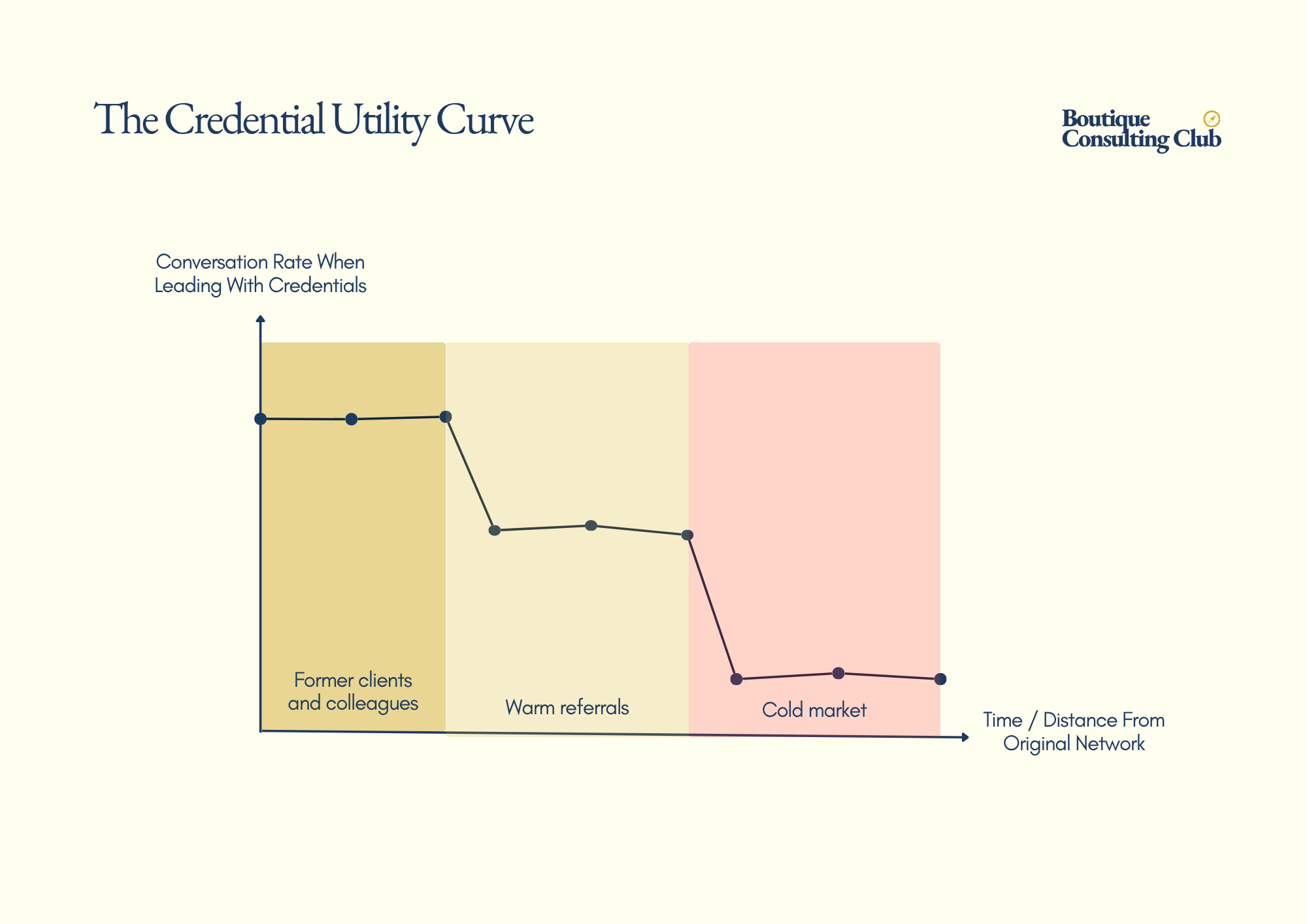
The first referral from a strong connector is usually the best one, the most obvious alignment between what you do and what the buyer needs. After that, referrals move further from the centre. The buyer is less clearly in the situation you’re best suited for. The trust being transferred is still real, but the fit is softer.
You see this in conversion rates: later-stage referrals tend to convert worse than early ones. Founders rarely track this explicitly, mostly because there isn’t enough data per connector to make the pattern obvious.
There’s also a network structure issue. The people who know you best (the strong ties that generate your warmest introductions) tend to know many of the same people you do. This has been well established in network theory: strong ties are dense. That density is what makes them powerful for trust, but it also limits their reach.
In practice, this means your best connectors are mostly reaching buyers you could get to yourself with one or two additional steps. You’re not really accessing new markets. You’re operating within the overlap of existing networks, which is smaller than it looks.
So the ceiling isn’t primarily about relationship quality or quantity, but how demand reaches the firm.
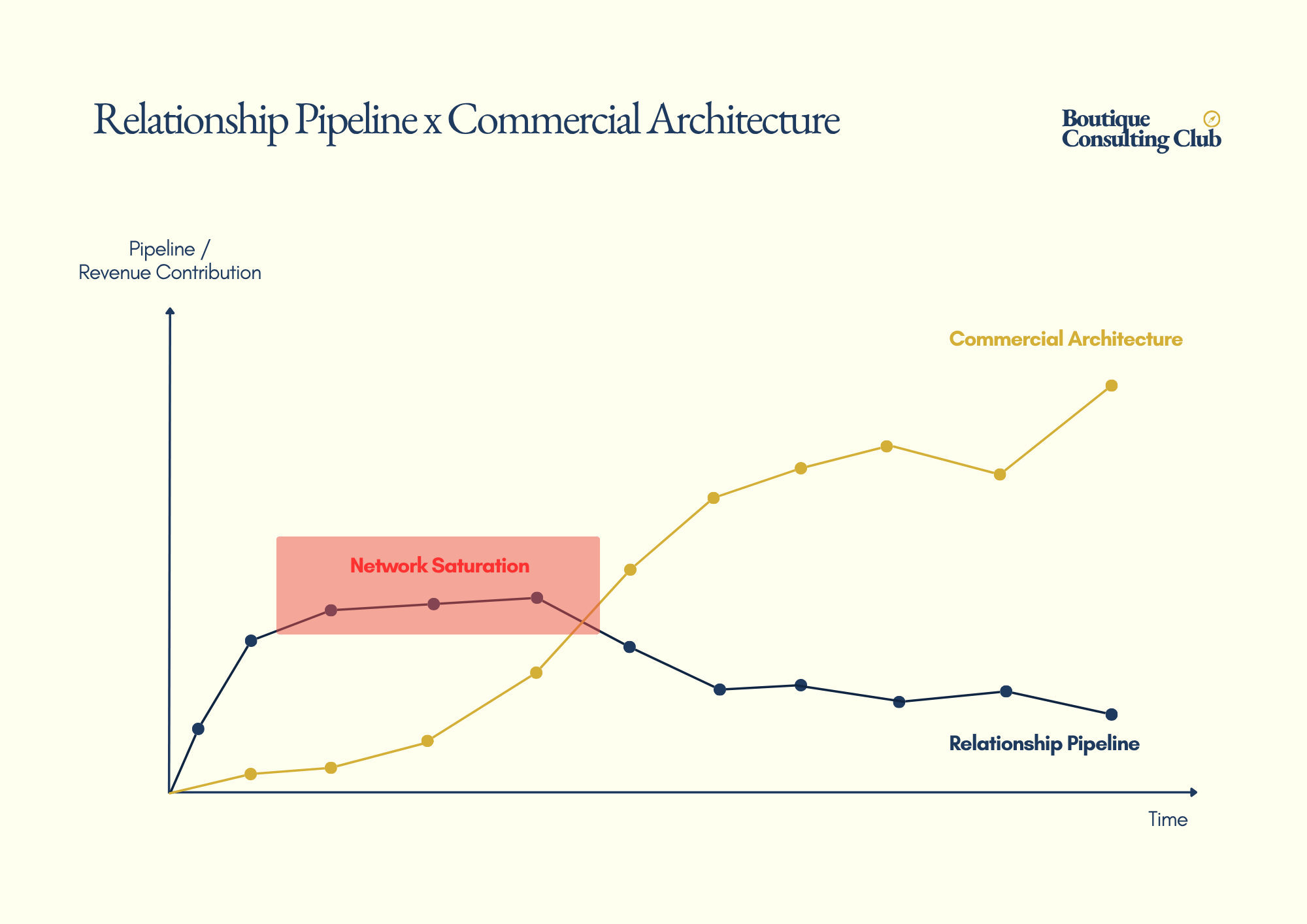
Relationship-driven growth has reach limits built into it. Getting past those limits requires building demand mechanisms that don’t rely on personal connection as the main transmission channel.
The Illusion Of Activity
What makes this genuinely hard to see from the inside is this reputation system doesn’t fail noisily. It tapers.
There are still conversations. Some of them are good. Proposals still go out. Some of them convert. Revenue continues - lumpy, hard to predict, but present. The founder is usually busy, because the engagements that came in 18 months ago are still running, and the relationships still produce the occasional introduction. Nothing has obviously broken.
What’s actually happening is that the system’s output is declining relative to the founder’s effort. The conversations that used to arrive without much prompting now require following up. The introductions that used to come spontaneously now require the founder to remind people of what they’re doing. Warm leads that used to convert fairly quickly now need more explanation, more back-and-forth, more nurturing.
The usual diagnosis for this pattern is almost always wrong. Founders who feel the taper tell themselves they need to be more visible. More content. A stronger LinkedIn presence. More speaking engagements. A better pitch deck. A marketing agency. More outreach. They invest in one or several of these things, produce a spike of activity, and then watch the activity fail to produce consistent pipeline.
The issue isn’t that the activity is poorly executed, but that it’s aimed at the wrong problem.
Visibility and outreach are demand-generation tactics. They work when there’s an underlying commercial system that can convert demand into real pipeline. When that system isn’t in place, more activity still creates more conversations - but those conversations skew toward the wrong kinds of buyers: exploratory calls, edge cases, proposals that stall out. The architecture determines what the activity converts into. Without it, effort goes in and exhaustion comes out.
Tim ran into this directly. He tried content: three months of posting on LinkedIn, a few articles that got strong engagement, and several interesting conversations as a result. None of them converted.
He told himself his positioning wasn’t clear enough and went back to thinking about how to describe what he did. That was a reasonable diagnosis. It wasn’t the right one.
What A Commercial Engine Actually Does
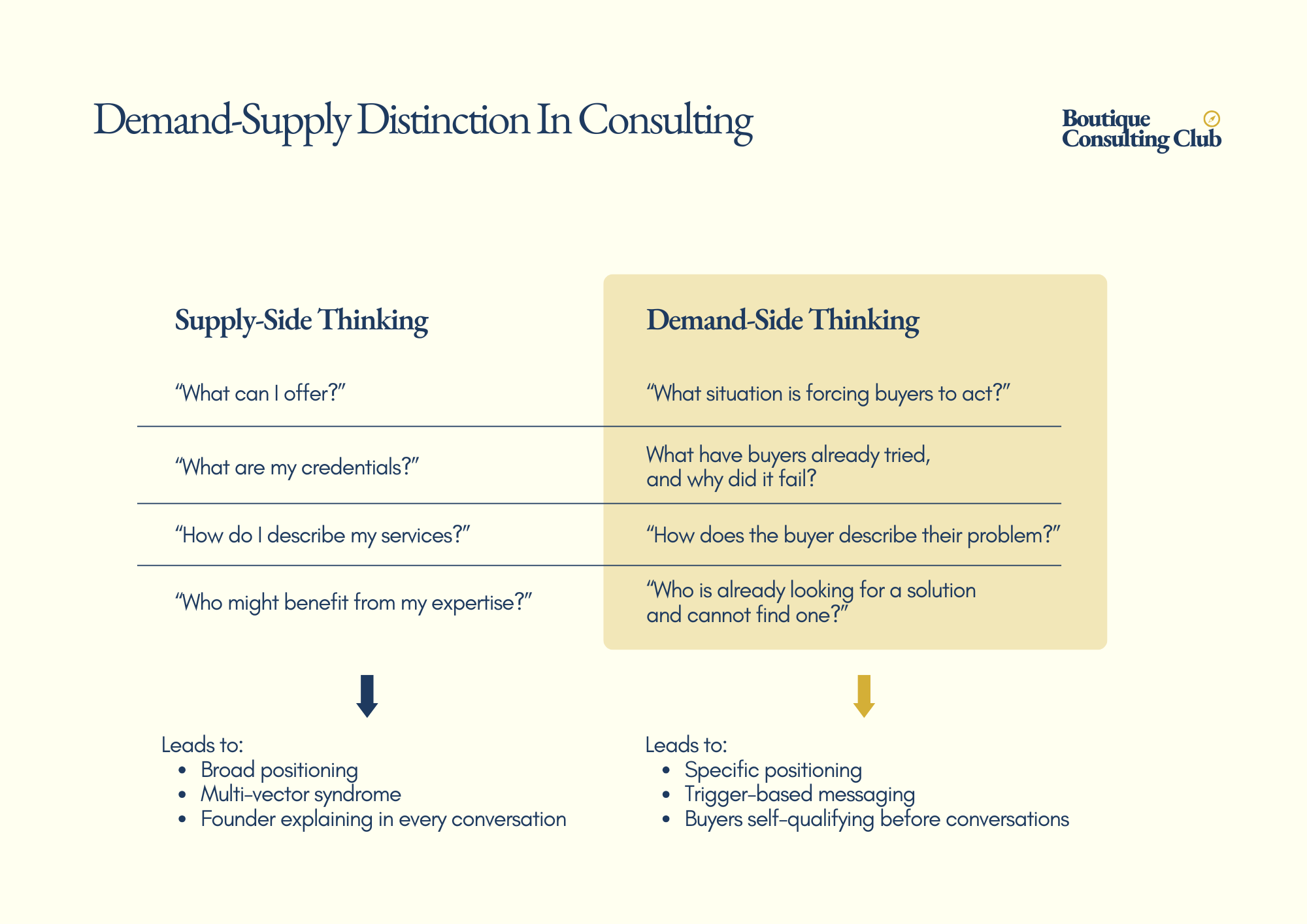
A founder with a functioning commercial engine can describe, in a single sentence, the specific situation in which buyers hire her. Not her capabilities, but the situation itself.
For example: “I help programme directors at FTSE 250 firms when a digital transformation initiative has reached the 18-month mark with no measurable ROI, and a board review is approaching.”
Every part of that sentence is doing work. It defines the buyer, the trigger, the timing, and the stakes. A connector who hears it can map it to a real person. A buyer reading it either recognises themselves immediately or knows it’s not relevant.
Her case study follows the same logic. It starts with the trigger, not her methodology. The opening lines describe the buyer’s world before she got involved. Then it shows what was actually broken, and why previous attempts hadn’t worked. It closes with a clear, measurable outcome.
New conversations come from multiple directions.
Some are referrals - but they’re specific, because the connector has a clear handle on when to make the introduction. Some are inbound, from buyers who come across her thinking and recognise their own situation in it. Others come from targeted outreach to buyers showing clear signals that they’re in that trigger situation.
No single channel carries the whole pipeline. And none depends entirely on any one relationship.
By the time a prospective buyer gets on a call, they’ve usually already formed a view. They’ve read something, seen a case study, or heard the situation described in a way that made them think, “this might be us.”
So the first conversation isn’t introductory, it’s diagnostic. She’s not starting from scratch or explaining what she does in general terms. She’s working out whether this buyer is actually in the situation she solves.
This is what Tim was missing.
He had strong relationships, credible experience, and a track record of good work. But the underlying commercial structure - the system that generates demand around specific trigger situations, supports it with proof, and doesn’t rely on his personal network to carry every conversation - hadn’t been built.
His relationships had been compensating for that gap. And they were starting to run out of runway.
The Honest Question
There’s a diagnostic most founders resist, because the answer is uncomfortable.
Go back through every engagement and serious commercial conversation from the last 18 months. For each one, write down not what you sold but where the conversation actually came from. Name the specific person or mechanism. Then ask, for each row: would this buyer have moved this fast if they hadn’t known me personally or through someone who vouched for me directly?
If the answer for more than 70 or 80% of rows is “probably not” - if the common thread across almost everything is personal trust rather than the buyer being in a specific situation that forced them to act - you are running a reputation system. That’s not a moral failure. It’s how every founder-led firm starts. It’s the honest description of a stage of development.
The question is whether it’s still how you want to be operating in 12 months.
Because the thing about reputation systems is that they are self-concealing. When they’re working, they look like a business. When they start to taper, they look like a temporary slowdown - something to push through with more effort, more visibility, more hustle. The founder who pushed hard for two years and built $400,000 on the strength of their reputation is not going to interpret a quiet quarter as evidence of a design problem. They’re going to interpret it as a temporary gap, a patch of bad luck, a sign that they need to do more of what worked before.
More of what worked before is the trap. What worked before was a reputation system running in conditions that no longer exist: a fresh network, relationships that hadn’t yet made their introductions, a market of people who knew the founder from their previous life and were ready to hire or refer. Those conditions don’t regenerate. The same effort in the same direction produces diminishing returns because the inputs have changed, not the effort.
The ceiling is real, and it’s not personal. It’s architecture.
Back To Tim
Six months after Thursday evening, Tim did something simple. He went back through his 16 rows and wrote down, for each engagement, not what he’d sold but what had changed in the buyer’s world immediately before they reached out.
12 of the 16 had the same answer in different forms. A structural event (a merger, an acquisition, a regulatory deadline, a new executive) had created a specific security exposure that the buyer’s existing team was not equipped to address. The trigger wasn’t “they needed cybersecurity help.” The trigger was a corporate event that moved faster than the organisation’s security architecture.
He had been selling cybersecurity advisory. What he’d actually been solving was post-event architecture exposure, specifically in the window after a structural change when an organisation is most vulnerable and least equipped.
Once he saw it, the pattern was obvious. It had been there in the data the whole time.
He rewrote his LinkedIn About section to open with the trigger. He rebuilt his case study to lead with the event rather than the methodology. He identified the connectors closest to those events as they happened - M&A lawyers, PE advisors, corporate restructuring partners - and gave them a handle specific enough to carry. He published a short piece about the 90-day post-acquisition exposure window.
3 of the next 4 commercial conversations came from referrals specifically triggered by the event pattern. 2 came from buyers who’d read the piece. None came from relationships that had generated pipeline before.
The ceiling hadn’t disappeared. But for the first time, he could see past it.
The pipeline that built his first $400,000 was a reputation system. Personal, relationship-dependent, excellent at close range. The pipeline he was starting to build was something different: a commercial architecture that matched a specific type of demand to a specific offer, and that could reach buyers he’d never met, through mechanisms that didn’t require him to personally know everyone in the chain.
He hadn’t reinvented his expertise. He’d stopped hiding it inside a list of capabilities and started deploying it in the precise situation where it did most of the work.
—
If you traced your last eighteen months of pipeline and found the same pattern Tim did, the next step isn’t a proposal or a sales process. It’s understanding what your commercial architecture actually looks like under the surface - what’s driving it, where it’s concentrated, and what it will take to build past the ceiling you can feel approaching. Our Pipeline Map might be helpful.